This is a structural problem, not a cyclical one. And almost nobody in lending understands it yet.
The timing mismatch
Here is the basic arithmetic of running an AI company that sells through enterprise channels or cloud marketplaces.
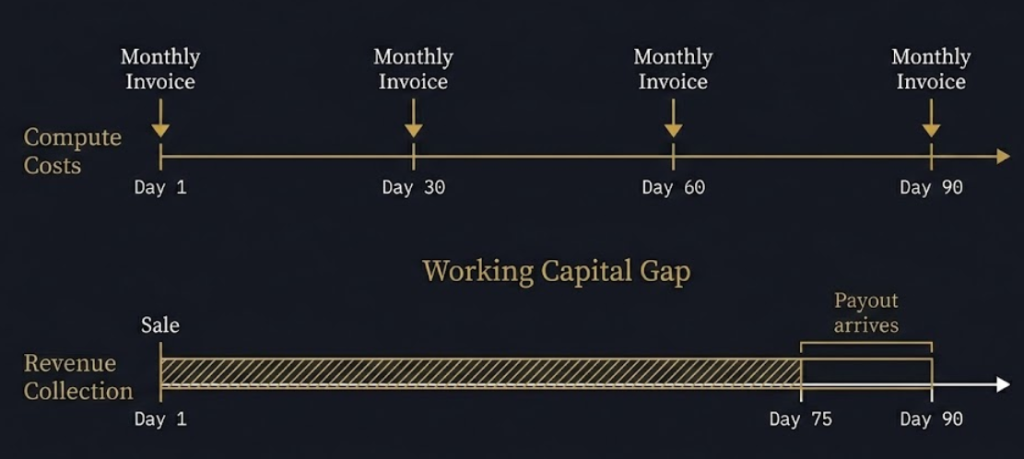
Your inference costs are due now. Every API call to OpenAI, Anthropic, or AWS Bedrock generates a bill. Most providers invoice monthly. Some require pre-paid compute commitments. The meter is always running.
Your revenue arrives later. Enterprise contracts pay net 30 to net 60. If you sell through the Microsoft Marketplace, AWS Marketplace, or Salesforce AppExchange, payout cycles run 30 to 90 days after the end of the billing period. Microsoft Partner Center, for instance, processes payouts around the 15th of the month for earnings that closed in the prior month. For a sale made on March 1st, you might not see the cash until mid-May.
The gap between these two dates is your working capital problem. And unlike most businesses, this gap grows proportionally with revenue. The more customers you land, the worse it gets.
Why banks say no
Walk into any high street bank or commercial lender with an AI company doing $2M in revenue and ask for a working capital facility. Here is what happens.
The credit analyst pulls your financials and sees gross margins between 25% and 60%. In traditional SaaS, gross margins run 80% to 90%. The analyst's model was built for SaaS. Your margins look distressed. Application denied.
What the analyst misses is that your cost of goods sold is fundamentally different from a traditional software company. In SaaS, COGS is mostly hosting and support. Small, predictable, relatively fixed. In AI, COGS is inference: the cost of running models against customer queries. It scales directly with usage. It is, in a real sense, more like manufacturing inventory than software overhead.
A clothing retailer with 50% gross margins would have no trouble getting a working capital line. Banks understand inventory. They understand that you buy materials, produce goods, sell them, and collect payment. The margin compression is expected.
But inference costs don't look like inventory on a balance sheet. There is no warehouse. No receivables ledger tied to physical goods. The bank's underwriting model simply has no category for "we spend $80K a month on API calls to generate revenue that arrives 60 days later."
This is not a temporary market gap. Basel III and its successors have systematically pushed banks away from small business lending for over a decade. In the US, business loans under $1 million have declined 5% since 2010 in real terms. Loans above $1 million are up 68% over the same period. The economics of underwriting a $500K credit facility for an AI startup simply don't work for a regulated bank.
Why revenue-based finance doesn't fit either
Revenue-based financing (RBF) was built for subscription SaaS. The model assumes predictable monthly recurring revenue, stable margins, and low churn. The lender takes a fixed percentage of monthly revenue until a predetermined multiple is repaid.
AI companies break this model in three ways.
First, revenue is often usage-based, not subscription-based. A document processing company might bill $0.03 per page extracted. An AI coding assistant might charge per seat but see wildly different compute loads per user. Monthly revenue can swing 30% or more based on customer activity. RBF lenders need to model repayment schedules, and volatile revenue makes that difficult.
Second, the margin structure creates concentration risk the lender didn't price for. If your largest customer accounts for 40% of revenue but generates compute costs that eat 70% of that revenue (because they run complex, token-heavy queries), the lender's percentage-of-revenue repayment is capturing dollars that are already spoken for. The borrower's actual free cash flow is much lower than top-line revenue suggests.
Third, RBF typically requires a fixed repayment period. But AI companies in growth mode are increasing compute spend faster than revenue in order to onboard new enterprise customers, build new model capabilities, or pre-purchase compute at volume discounts. A fixed repayment schedule during a scaling phase creates exactly the kind of cash squeeze the financing was supposed to prevent.
The Stripe paradox
Stripe's 2025 annual letter contains a remarkable data point: businesses that received Stripe Capital offers grew 27 percentage points faster than those that didn't. The Collison brothers wrote that "access to capital will become a more important factor in economic outcomes over the coming years, as advances in artificial intelligence increase the returns on investment."
They are right. And the irony is that the companies best positioned to benefit from working capital, AI companies with strong unit economics and growing enterprise revenue, are precisely the ones that existing lenders struggle to serve.
Stripe Capital works because Stripe has real-time visibility into the borrower's payment flows. Repayment is automatic: a percentage of every transaction is withheld. The borrower never misses a payment because the payment infrastructure is the lending infrastructure.
But Stripe Capital only serves businesses that process payments through Stripe. An AI company selling through Microsoft Marketplace, collecting revenue through AWS, or billing enterprise customers on net-60 terms sits on entirely different rails. Stripe doesn't see their revenue. The same structural advantage that makes Stripe Capital work, payment-level data and automatic sweeps, is absent.
This gap is where the opportunity sits.
What underwriting should actually look like
If you were designing a working capital product specifically for AI companies, you would start from different first principles than any existing lender.
You would connect directly to inference cost APIs. Not bank statements. Not accounting exports. The actual billing data from OpenAI, Anthropic, Google, or AWS Bedrock. This gives you real-time visibility into the borrower's primary cost driver.
You would connect to marketplace payout APIs. Microsoft Partner Center, AWS Marketplace Management Portal, Salesforce AppExchange. This gives you the revenue side, with actual payout timing, not reported revenue.
From these two data sources, you can calculate the metric that actually matters: revenue generated per dollar of inference cost. This ratio tells you whether the business has healthy unit economics after its primary variable cost. A company generating $2.50 in marketplace revenue for every $1.00 spent on inference has a fundamentally sound business, regardless of what its blended gross margin looks like on a P&L.
Repayment would be structured by taking the full balance of incoming marketplace payouts to clear your obligations, with the residual immediately flowing back to your account. Not a fixed monthly amount. Not a percentage of top-line revenue. An application of actual cash arriving in the account. This aligns the lender's cash flows with the borrower's and eliminates the timing mismatch that created the problem in the first place.
Credit limits would adjust in real time as the underlying data changes. Revenue growing and inference efficiency improving? The limit increases automatically. Customer concentration spiking or margins deteriorating? The limit contracts. No annual reviews. No document requests.
This is not a theoretical exercise. Every component described above is technically feasible today. The APIs exist. The payout data is accessible. The sweep mechanism is proven (Stripe Capital, Shopify Capital, and Amazon Lending all use variants of it). What doesn't exist yet is a lender that combines these components specifically for AI company economics.
The scale of the opportunity
The population of AI companies hitting this working capital wall is growing faster than anyone expected. Stripe reported that companies in their 2025 cohort grew 50% faster than those in 2024. The number of companies reaching $10M in annual recurring revenue within three months of launch doubled year on year. GitHub pushes surged 41%. iOS app releases jumped 60%.
Many of these companies will sell through cloud marketplaces because that is where enterprise buyers increasingly discover and procure software. Microsoft alone lists over 4,000 AI applications on its marketplace. AWS and Salesforce are growing their AI app directories at similar rates.
Every one of these companies faces the same structural timing mismatch. The compute bill is due before the payout arrives. The margins look wrong to traditional lenders. And the existing working capital products were designed for a different era of software economics.
Someone will build the right solution. The question is when.
Nils Hertzner | Floatcap — working capital infrastructure for AI companies.
If you are an AI company experiencing the working capital dynamics described above, we would like to hear from you. Join the waitlist.